- +1 (888) 990-7177
- monarchcontractors@mail.com
- 501 Cambria Avenue Bensalem, PA 19020

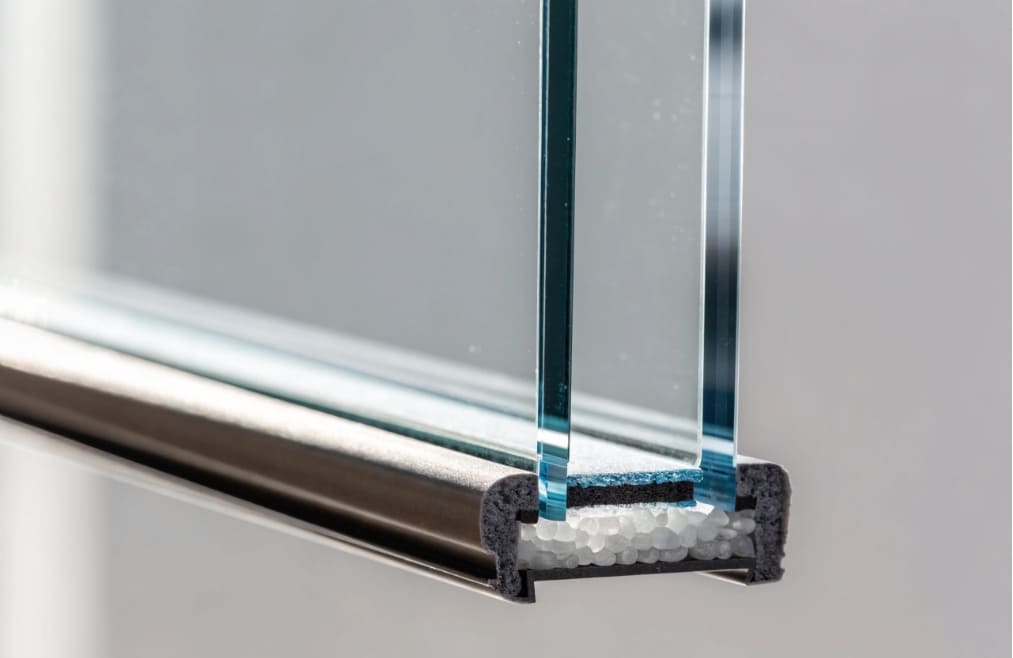
When you look at a replacement window, you see glass. What you do not see is the sealed cavity between the panes — and that hidden space does much of the thermal work. Manufacturers fill it with an inert gas because these gases insulate better than ordinary air. The two names you will encounter are argon and krypton. Understanding the difference helps you avoid both underspending on performance and overpaying for a feature your climate does not need.
At Monarch Contractors, we install OKNA vinyl windows across the Philadelphia suburbs, South Jersey, and the Pocono Mountains. Because OKNA windows are manufactured locally in Bristol, PA, we have a close working knowledge of how their glass packages are built. The right gas fill depends on your glass package, your gap width, and your ENERGY STAR climate zone. Below, we explain the physics in plain terms and translate it into a clear recommendation.
A modern energy-efficient window is built around an insulating glass unit (IGU): two or three panes held apart by a spacer and hermetically sealed at the edges. That sealed cavity could hold plain air. Instead, manufacturers pump in a noble gas, because heat moves more slowly through it.
Heat crosses the gap three ways. Conduction transfers energy molecule to molecule through the gas itself. Convection occurs when the gas circulates in a loop, physically carrying warmth from the inner pane to the colder outer pane. Radiation sends infrared energy directly across the cavity. In a clear double-glazed window, radiation accounts for roughly half of the heat loss.
This is why a gas fill never works alone. A low-emissivity (low-E) coating — a microscopically thin metallic layer on the glass — suppresses the radiant half of the heat transfer. Once radiation is controlled, conduction and convection dominate the remaining loss, and that is exactly what a low-conductivity gas attacks. A warm-edge spacer completes the system by reducing heat loss around the perimeter of the glass, where older aluminum spacers used to bleed cold and trigger condensation. Low-E coating, gas fill, and warm-edge spacer are three parts of one insulating system.
Argon is the gas inside most quality replacement windows, and for good reason. It conducts heat at roughly 0.018 W/m·K — about 33% lower than air’s 0.026 W/m·K. It is also about six times denser than air, which slows the convective loop that would otherwise ferry heat across the gap.
Just as important, argon is practical. It makes up just under 1% of the atmosphere and is produced cheaply as a byproduct of separating oxygen from air. The cost to the homeowner is a few dollars per window — a negligible premium for a meaningful gain. Windows are typically filled to about 90% or higher argon concentration, and the thermal benefit scales with that fill level.
Argon performs best at a gap of about half an inch (roughly 12–13 mm). This is the convenient part: standard double-pane IGUs are already built to approximately that dimension. The gas and the geometry match. OKNA’s standard double-pane low-E argon package lands at a U-factor of 0.27–0.30, roughly half the heat loss of the 1970s and 1980s aluminum-frame windows it usually replaces.
Krypton insulates better than argon. Its thermal conductivity is about 0.009 W/m·K — roughly 64% lower than air, and roughly half that of argon. It is also about twelve times denser than air. On the spec sheet, krypton wins.
The catch is gap width. Krypton performs best in a very narrow cavity — about a quarter inch to three-eighths of an inch (6–9 mm). That is far tighter than argon’s optimum, which makes krypton the natural fill for triple-pane windows, where three panes must fit inside a frame of normal depth and each cavity is forced narrow. In those tight gaps, argon underperforms and krypton excels.
Cost is the other constraint. Krypton exists in the atmosphere at only about one part per million and is expensive to extract. Depending on the source, krypton runs anywhere from roughly 200% to 300% more for a triple-pane krypton unit versus a double-pane argon one. Because of this, manufacturers often use argon-krypton blends to balance cost against performance. Krypton earns its premium in triple-pane construction, Passive House projects, and slim-profile designs that still demand high performance — not in a standard double-pane window.
Every gas has an optimal cavity thickness, set by a tug-of-war between two effects. Conduction decreases as the gap widens, because there is more gas for heat to cross. Convection does the opposite: past a certain width, the gas is free to circulate in a loop, actively carrying heat across the cavity. The best gap is where those two curves cross.
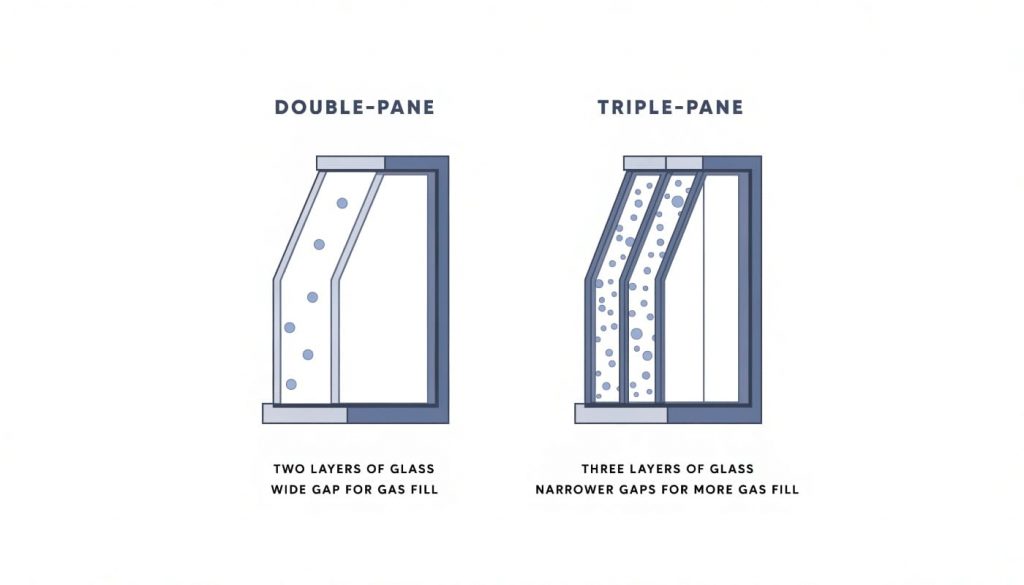
For air and argon under U.S. test conditions, that crossover is about half an inch. Krypton forms convective loops more easily, so its penalty kicks in at a smaller gap, pushing its optimum down to roughly a quarter inch. This is the entire reason krypton “wants” a narrow space and argon “wants” a wider one. It also explains why simply widening an air gap eventually stops helping — beyond the optimum, convection takes over and the window only gets heavier, not better.
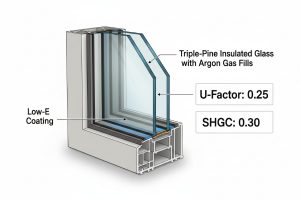
The gas fill is a genuine upgrade, but a supporting one. In a clear, non-low-E double-pane window, adding argon improves the U-factor by only about 10%. In a low-E double-pane window, that same argon delivers roughly a 17% improvement — moving the U-factor from about 0.30 to 0.25. Krypton at optimal spacing can push the total improvement to about 25% over air.
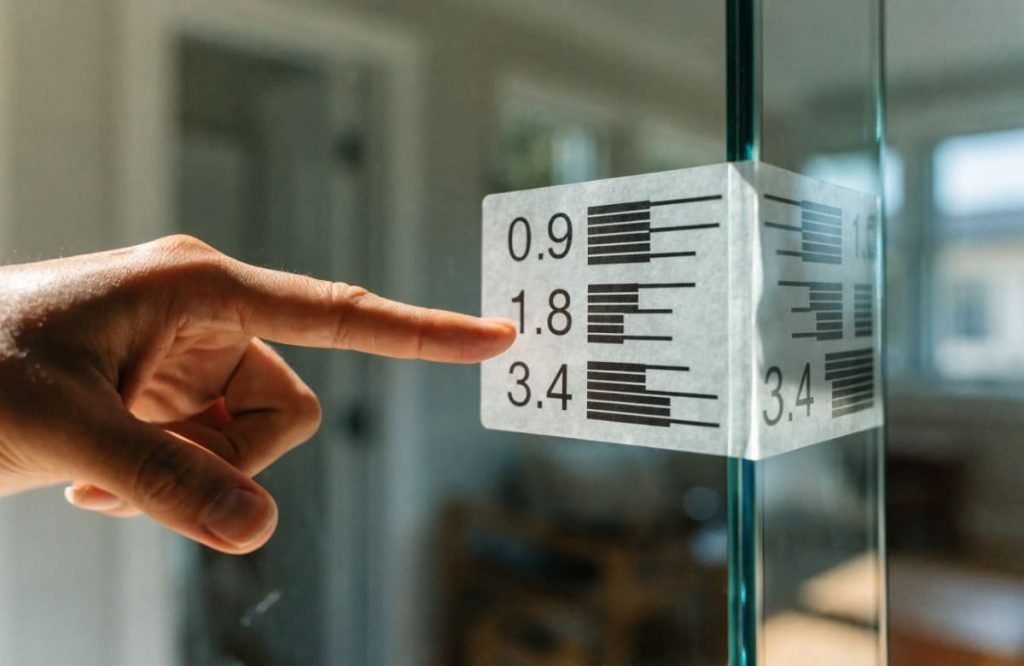
One caveat matters for shoppers: these figures describe the center of the glass. The whole-window U-factor printed on the NFRC label is higher, because the frame and glass edges conduct more heat. Always compare windows on the whole-window number, not the center-of-glass claim. A practical takeaway follows from the math: if you want more performance than low-E-plus-argon delivers, adding a third pane or a second low-E coating usually beats swapping argon for krypton in a double-pane unit.
| Property | Air | Argon | Krypton |
|---|---|---|---|
| Thermal conductivity (W/m·K) | ~0.026 | ~0.018 | ~0.009 |
| Reduction vs. air | — | ~33% | ~64% |
| Optimal gap width | ~½ inch | ~½ inch (12–13 mm) | ~¼ inch (6–9 mm) |
| Best application | Basic glazing | Double-pane low-E | Triple-pane low-E |
| Relative cost | Lowest | Low (a few dollars/window) | High (200–300% more for triple-pane) |
| Atmospheric abundance | — | ~0.9% of air | ~1 part per million |
Gas fills matter in proportion to the temperature difference between inside and outside. The colder it gets relative to your heated interior, the more work the gas layer does. ENERGY STAR divides the country into zones, and our service area straddles two of them — which is why the right answer is not the same in every town we serve.
Monroe, Pike, Carbon, and Wayne counties sit in ENERGY STAR’s colder Northern zone. Under the tightened Version 7.0 criteria, effective October 23, 2023, Northern-zone windows must reach a U-factor of 0.22 or lower, with a minimum solar heat gain coefficient added to capture beneficial winter sun. Hitting that target generally requires triple-pane glass — exactly the narrow-cavity construction where krypton or an argon-krypton blend belongs. The Poconos’ deep winters, large temperature swings, snow load, and freeze-thaw cycling make the strongest possible glazing package a sound investment.

Bucks, Montgomery, Chester, Delaware, and Philadelphia counties in Pennsylvania, along with the South Jersey counties, fall in the milder North-Central zone, where Version 7.0 requires a U-factor of 0.25 or lower. A quality low-E argon double-pane window meets this comfortably. For a closer look at what this means for budgets in the city and inner suburbs, see our window replacement cost guide for Philadelphia. Triple-pane and krypton remain optional comfort upgrades here — worth considering for large north- or west-facing glass, persistent cold spots, an under-insulated older home, or serious noise concerns, but not a necessity for most homes.
Trust the label, not the brochure. The NFRC label — often on the spacer or along the bottom track — lists the U-factor, and the product description states the gas fill. A double-pane window rated at or below 0.30 almost certainly combines gas and a low-E coating. The separate ENERGY STAR label confirms the unit meets EPA criteria for a specific climate zone; for the federal tax credit, look for ENERGY STAR Most Efficient certification at a U-factor of 0.20 or lower.
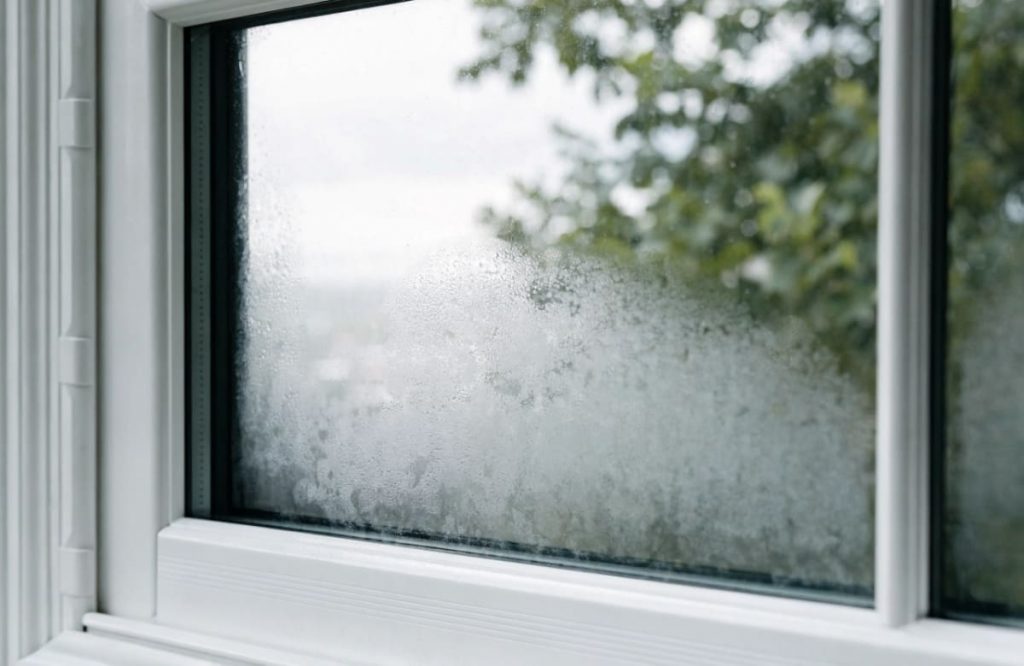
Gas leaves a sealed unit slowly — the NFRC estimates roughly half a percent per year, so a well-built window keeps most of its fill for decades. The warning sign of a failed seal is fog or condensation trapped between the panes, which means the gas has been replaced by moist air and the unit needs service. Leaked argon or krypton is non-toxic and harmless to your household.
For most homes in the Philadelphia suburbs and South Jersey, low-E argon double-pane glass is the efficient, cost-effective standard — it meets ENERGY STAR Version 7.0 and delivers the bulk of the available savings for a few dollars more than plain air. In the Poconos, we recommend stepping up to triple-pane, where krypton or an argon-krypton blend earns its place inside the narrow cavities. In every case, we specify the whole-window U-factor and the correct climate-zone certification for your county, then select the glass package that hits the target most cost-effectively.
To find the right glass package for your home and climate zone, explore our window replacement services or call Monarch Contractors at +1 (888) 990-7177 for a free in-home estimate.