- +1 (888) 990-7177
- monarchcontractors@mail.com
- 501 Cambria Avenue Bensalem, PA 19020

When choosing replacement windows for Pennsylvania or New Jersey properties, understanding U-Factor and Solar Heat Gain Coefficient (SHGC) becomes absolutely essential for making informed decisions about energy efficiency, comfort, and long-term cost savings. These two critical metrics determine how effectively windows perform in controlling heat transfer and solar radiation—directly impacting your heating and cooling expenses throughout our region’s demanding four-season climate.
At Monarch Contractors, we’ve installed hundreds of thousands of energy-efficient windows across Pennsylvania and New Jersey since 1991. Below, we’ll explain exactly what these ratings mean, how they work together, and which specifications perform best in our Mid-Atlantic climate zone.
Ready to upgrade to high-performance windows? Call (888) 990-7177 for your free in-home assessment today.
The U-Factor measures the rate at which a window conducts non-solar heat flow. In simpler terms, this rating tells you how well a window prevents heat from escaping or entering your building. U-Factor values typically range between 0.20 and 1.20, with lower numbers indicating better insulating properties.
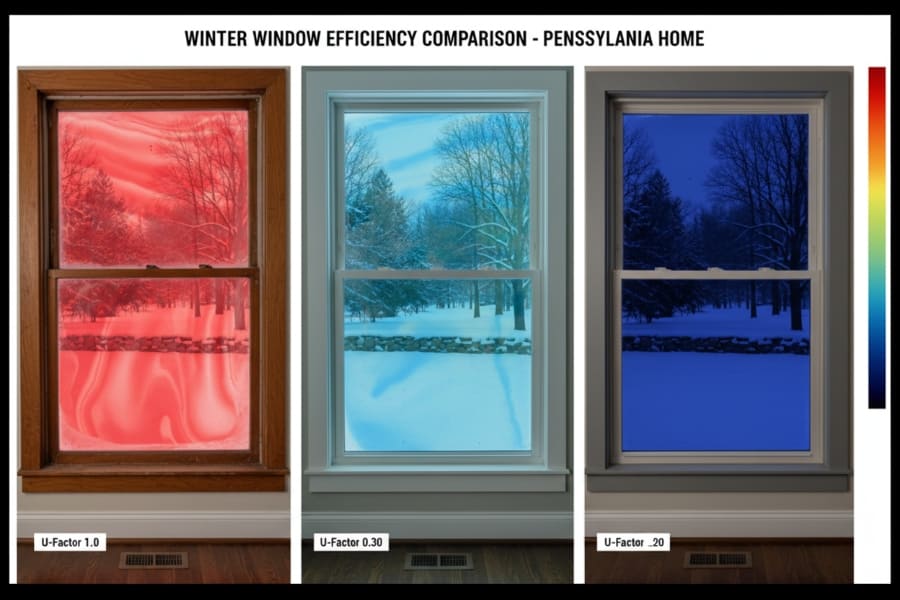
When evaluating U-Factor ratings, you’re essentially looking at thermal conductance. A window with a U-Factor of 0.30 insulates significantly better than one rated at 0.50—meaning less heat escapes during Pennsylvania’s cold winters and less heat penetrates during New Jersey’s humid summers. This metric proves particularly crucial in our climate zone (Northern/North-Central), where temperature extremes drive substantial heating and cooling costs.
For Pennsylvania and New Jersey homes, ENERGY STAR recommends windows with U-Factor values of 0.30 or less. For superior energy performance in our region, target U-Factor values of 0.25 or below—especially for north-facing exposures and homes in the Poconos or other mountainous areas experiencing harsher winter conditions.
Several architectural and material factors influence the overall U-Factor rating of window assemblies installed by Monarch Contractors:
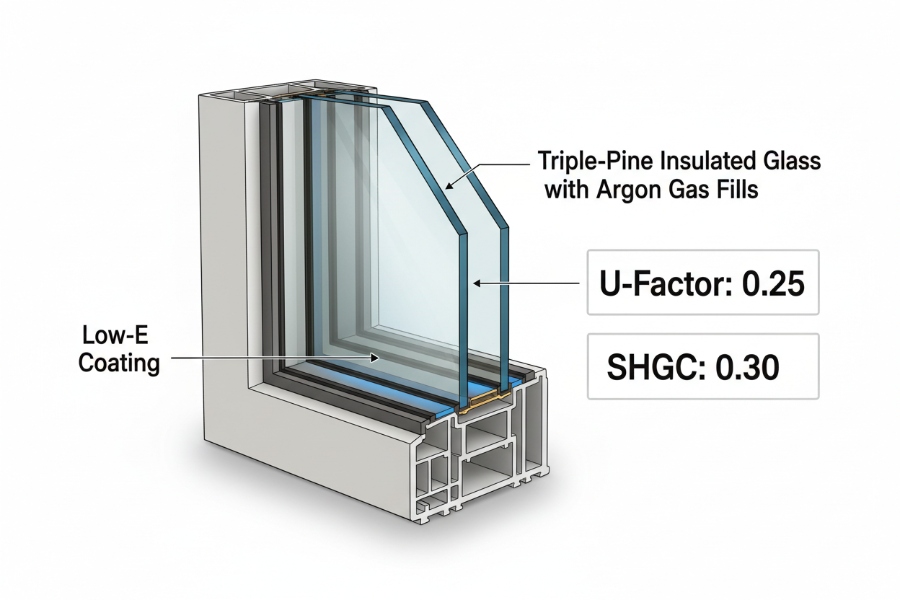
Glass panes represent the primary component affecting thermal performance. Single-pane windows—still found in many older Pennsylvania and New Jersey homes—typically exhibit U-Factor values between 0.90 and 1.10. Double-pane configurations reduce this dramatically to approximately 0.30 to 0.55, while triple-pane windows achieve even better ratings, sometimes reaching as low as 0.15 to 0.30.
Gas fills between panes substantially improve insulation. The energy-efficient windows we install commonly use argon or krypton gas, both of which conduct heat more slowly than air. Argon-filled windows typically perform 10-15% better than air-filled alternatives, while krypton provides even superior performance in narrow gap applications.
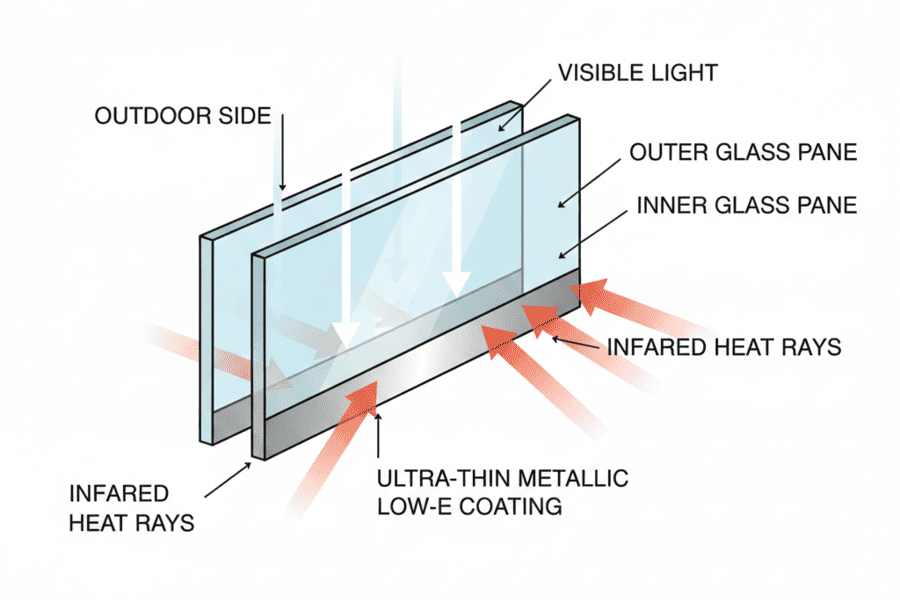
Low-emissivity (Low-E) coatings consist of microscopically thin metallic layers applied to glass surfaces. These coatings reflect infrared energy while allowing visible light to pass through, significantly reducing U-Factor values without compromising natural daylight transmission. Every window Monarch Contractors installs includes Low-E coatings as standard—essential for Pennsylvania and New Jersey’s climate demands.
Frame materials contribute substantially to overall window performance. The vinyl, fiberglass, and composite frames we install generally outperform aluminum in thermal resistance, though modern aluminum frames with thermal breaks have narrowed this performance gap considerably. In our region’s temperature extremes, frame selection makes a measurable difference in long-term energy costs.
Warm-edge spacer systems separating glass panes also impact U-Factor. Quality windows installed by Monarch Contractors use warm-edge spacer technology to reduce heat transfer at window edges, where thermal bridging typically occurs most severely in Pennsylvania and New Jersey’s four-season climate.
The Solar Heat Gain Coefficient measures how much solar radiation passes through a window and releases heat inside your building. SHGC is expressed as a number between 0 and 1, where lower values indicate less solar heat transmission.
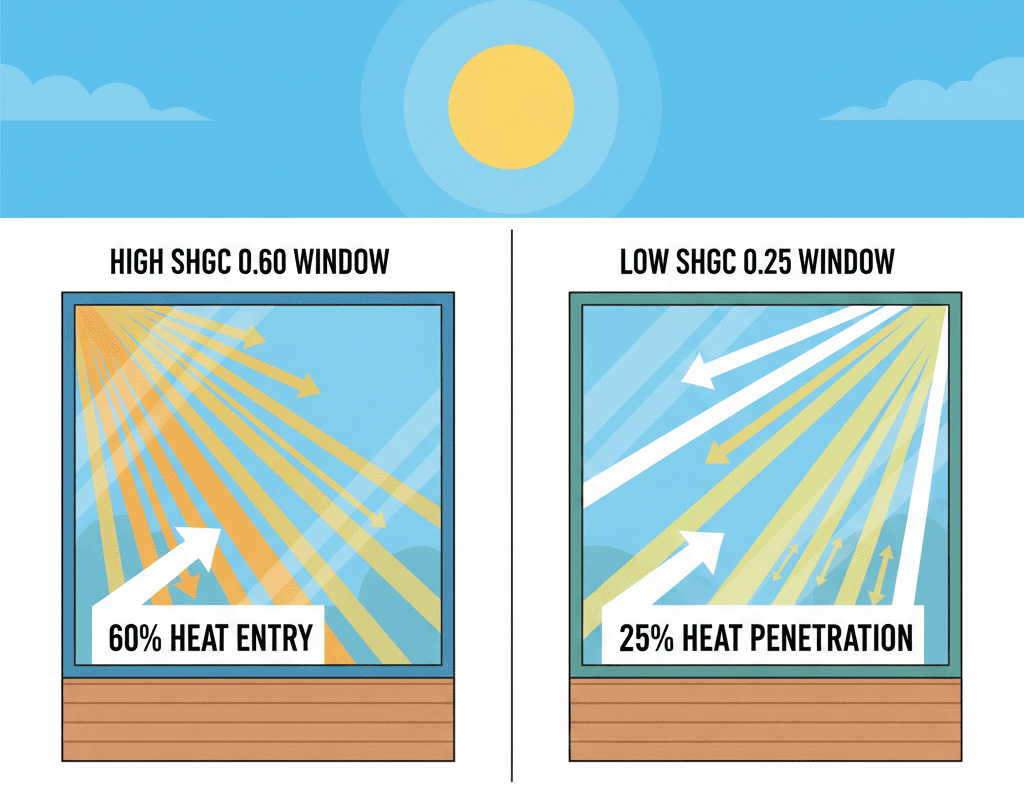
A window with an SHGC of 0.25 allows approximately 25% of available solar heat to enter while blocking the remaining 75%. This metric proves essential for managing cooling loads during hot Pennsylvania and New Jersey summers, when excessive solar gain drives air conditioning costs upward dramatically—particularly in Philadelphia, Trenton, Cherry Hill, and other urban areas with significant cooling demands.
Pennsylvania and New Jersey occupy a mixed climate zone requiring balanced window specifications. ENERGY STAR recommends SHGC values of 0.40 or less for most of our region, with lower values (0.25-0.30) ideal for homes with significant air conditioning costs or summer overheating issues.
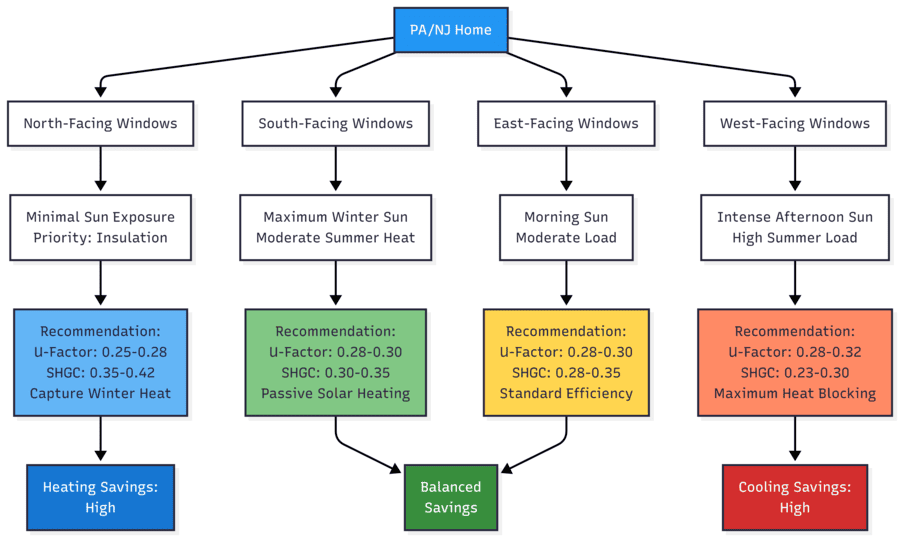
South-facing and west-facing windows particularly benefit from lower SHGC glazing (0.25-0.32) in Pennsylvania and New Jersey homes, as these orientations receive the most intense solar radiation. During consultation visits throughout Philadelphia, Bucks County, Montgomery County, Burlington County, and Mercer County, our project managers help homeowners select optimal SHGC values for specific window orientations.
North-facing windows can utilize slightly higher SHGC values (0.35-0.40) to capture some beneficial passive solar heat during winter months without creating significant cooling loads during summer. This strategy proves particularly effective in northern Pennsylvania locations like the Poconos, where heating costs dominate annual energy expenses.
Many Pennsylvania and New Jersey homeowners worry that low SHGC windows will darken their interiors, but modern spectrally selective coatings have largely eliminated this concern. These advanced Low-E coatings—standard in all Monarch Contractors installations—filter infrared radiation (heat) while transmitting visible light wavelengths. Quality windows can achieve SHGC values as low as 0.23 while maintaining visible transmittance above 50%, ensuring bright, naturally lit spaces without excessive solar heat gain.
These two ratings function independently but must be considered together when selecting windows for our region’s climate. A window might excel in one metric while underperforming in another, making the selection process more nuanced than simply choosing the lowest available numbers.
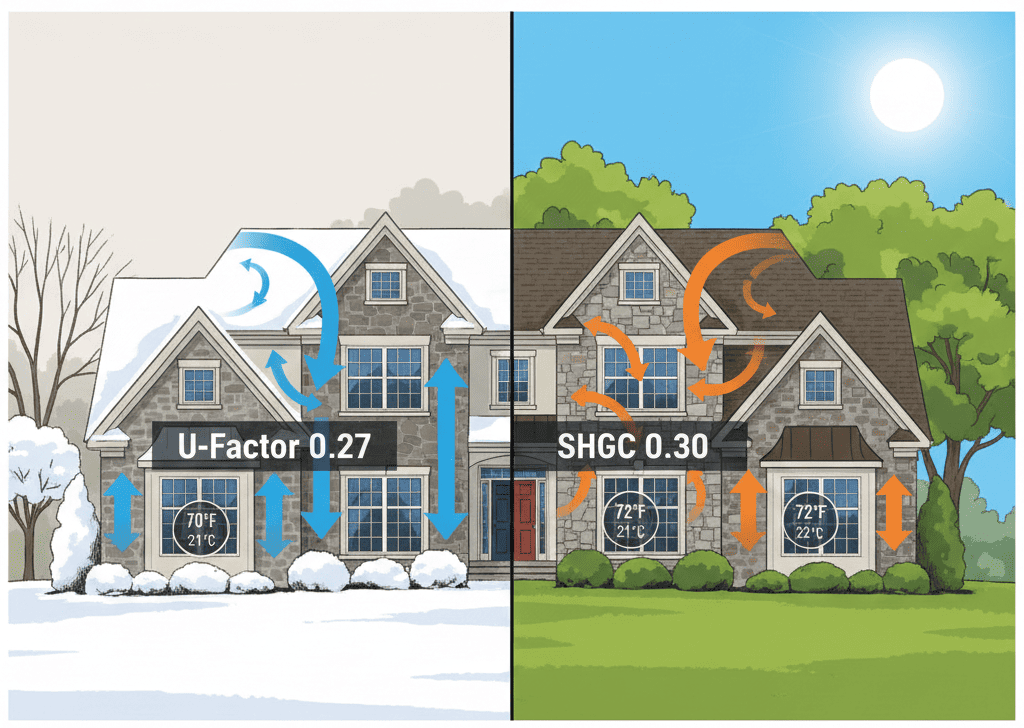
Winter performance in Pennsylvania and New Jersey depends primarily on U-Factor. During our heating seasons—which can extend from October through April in many areas—you want windows that prevent interior heat from escaping while potentially capturing solar warmth. A window with a U-Factor of 0.30 and SHGC of 0.40 performs excellently in our climate, providing strong insulation while harvesting passive solar heat that reduces furnace operation.
Summer performance throughout Philadelphia, Trenton, and surrounding areas relies heavily on SHGC. During cooling seasons, blocking solar radiation becomes paramount for reducing air conditioning loads and managing the high humidity common to our region. That same window with U-Factor 0.30 and SHGC 0.40 works well, though homes with significant cooling costs might benefit from SHGC values closer to 0.25-0.30 on sun-exposed elevations.
Year-round efficiency for Pennsylvania and New Jersey homes requires optimizing both metrics. Based on over three decades installing windows throughout our service area, Monarch Contractors typically recommends:
The ENERGY STAR program provides simplified guidance for Pennsylvania and New Jersey consumers, establishing minimum performance criteria specifically for our Northern/North-Central climate zone. Current ENERGY STAR requirements for our region include:
The National Fenestration Rating Council (NFRC) label provides standardized, verified performance data for U-Factor, SHGC, visible transmittance, and air leakage. Monarch Contractors exclusively installs windows bearing NFRC certification, ensuring ratings reflect actual tested performance rather than unverified manufacturer claims. During your free in-home assessment, our specialists walk you through these numbers and show you how different products compare for your specific needs and budget.
Schedule your free window consultation: (888) 990-7177
Based on installing windows throughout Philadelphia, Doylestown, Newtown, Langhorne, Trenton, Cherry Hill, Mount Laurel, and dozens of other Pennsylvania and New Jersey communities since 1991, Monarch Contractors recommends the following specifications for optimal year-round performance in our climate:
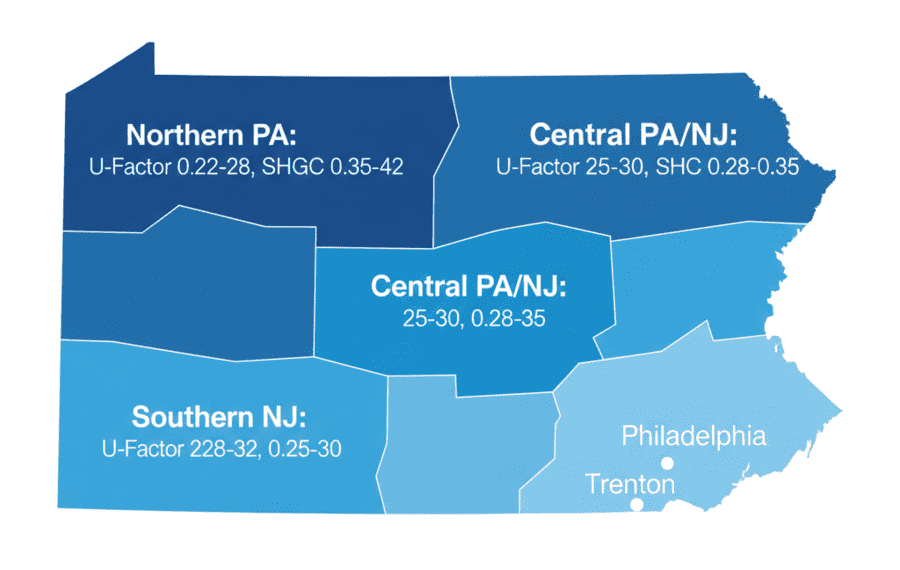
Remember that south-facing and west-facing windows often warrant different SHGC values than north-facing installations. Our project managers provide room-by-room recommendations during in-home consultations, optimizing performance while managing costs.
Triple-silver Low-E coatings incorporate multiple microscopic metallic layers, providing exceptional solar control while maintaining high visible light transmission. These advanced coatings—available on premium window products we install—achieve SHGC values as low as 0.19 with visible transmittance still exceeding 40%, ideal for Pennsylvania and New Jersey homeowners prioritizing maximum cooling cost reduction.
Warm-edge spacer technology significantly reduces condensation along window edges—a common problem in Pennsylvania and New Jersey’s humid climate. The quality windows Monarch Contractors installs use warm-edge spacers constructed from low-conductivity materials that minimize thermal bridging while improving long-term durability in our temperature extremes.
Impact-resistant glazing combines energy efficiency with storm protection—increasingly important for coastal New Jersey properties and areas experiencing severe weather. These windows meet both ENERGY STAR requirements and impact resistance standards, providing comprehensive performance in demanding applications.
Upgrading to high-performance windows requires substantial upfront investment, but energy savings accumulate over decades of service life. The U.S. Department of Energy and ENERGY STAR estimate that replacing single-pane windows with ENERGY STAR-certified units saves Pennsylvania and New Jersey households between $126 and $465 annually. Even upgrading older double-pane clear-glass windows to modern ENERGY STAR models saves approximately $27-$111 per year.
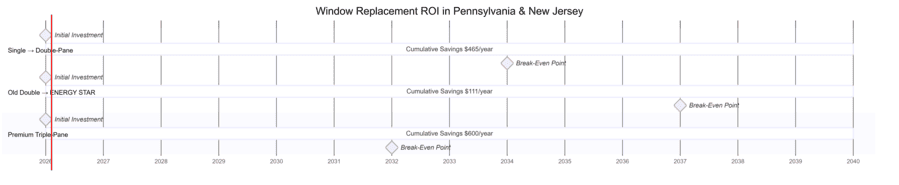
In Pennsylvania and New Jersey homes with temperature extremes, total reductions in heating and cooling costs of 15-40% are realistic when replacing failing units with the high-performance windows Monarch Contractors installs. Simple payback periods typically range from 8 to 15 years depending on replaced window conditions and energy prices.
Federal tax credits currently provide homeowners up to 30% of window costs (up to $600 annually for windows specifically) when purchasing ENERGY STAR-certified products. Additionally, Pennsylvania and New Jersey residents may qualify for state-level rebates and utility company incentives that vary by location and provider. Monarch Contractors helps you identify qualifying products during consultation and provides necessary documentation—including NFRC labels and installation certificates—to support tax credit claims.
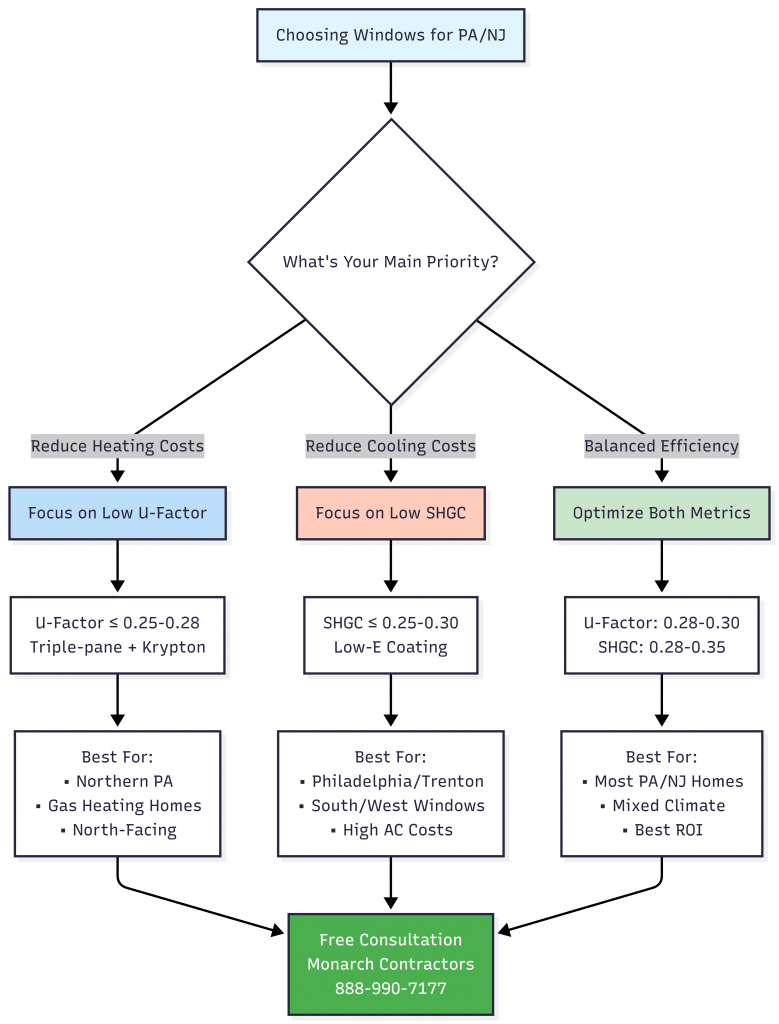
We recommend developing comprehensive specifications considering climate zone, building orientation, existing HVAC capacity, budget constraints, and aesthetic preferences. Professional energy modeling—which Monarch Contractors can arrange—quantifies expected savings from various window specifications, helping justify premium products where performance gains warrant additional investment.
During free in-home assessments throughout Pennsylvania and New Jersey, our project managers:
Understanding U-Factor and SHGC empowers you to make evidence-based decisions about window investments, balancing thermal performance, solar control, natural lighting, and financial considerations. These metrics provide the foundation for creating comfortable, efficient Pennsylvania and New Jersey homes that minimize environmental impact while maximizing year-round comfort.
Even the best windows underperform if installed improperly. Gaps, inadequate shimming, or insufficient sealing create drafts and moisture issues that cancel out the benefits of modern glass and frames. That’s why Monarch Contractors handles the entire installation process with our own in-house crews—never outside subcontractors—and backs window installations with a lifetime product warranty and 10-year workmanship guarantee.
Ready to upgrade to energy-efficient windows optimized for Pennsylvania and New Jersey’s climate? Call (888) 990-7177 or request your free estimate online.